Pioneer DJ DJM-A9 4 Channel DJ Mixer: A Technical Look at the New Club Standard
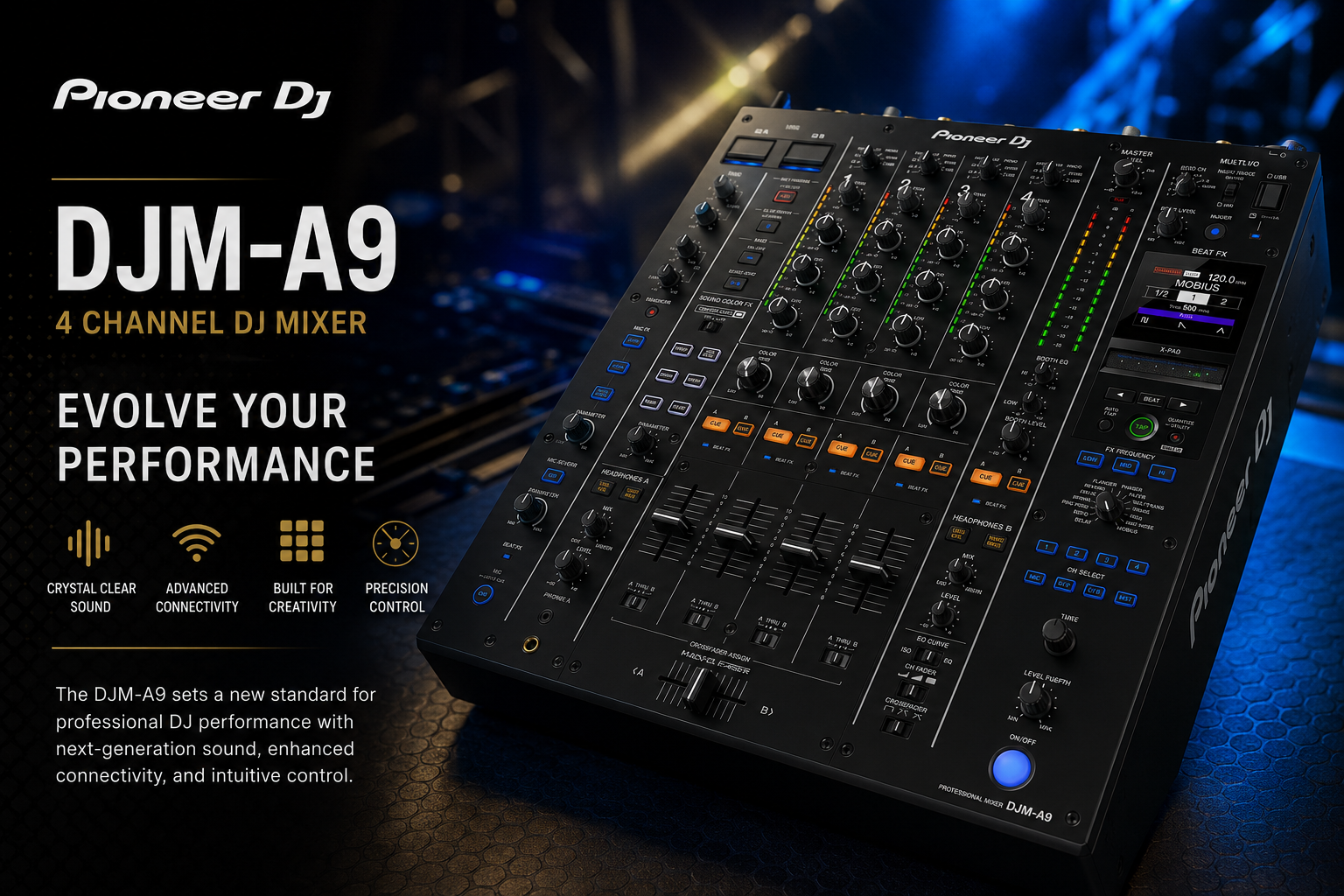
For DJs, audio engineers, backline techs, and production crews, the mixer sitting at the center of the booth is not just a creative tool. It is the control surface, routing hub, audio interface, effects engine, cue system, and often the final point of contact before signal heads toward the PA.
That is why the Pioneer DJ DJM-A9 matters.
As the successor to the DJM-900NXS2, the DJM-A9 is designed to carry the “club standard” format forward while improving sound quality, workflow, connectivity, monitoring, and performance control. It keeps the familiar 4-channel layout that touring DJs expect, but underneath that familiar Pioneer DJ architecture is a mixer with meaningful technical upgrades.
For event producers and AV teams, the DJM-A9 is not simply a rider-friendly DJ mixer. It is a serious professional tool that can handle festivals, club nights, private events, brand activations, corporate entertainment, live-streamed DJ sets, hybrid shows, and high-pressure changeovers.
A Familiar 4-Channel Layout, Refined
The DJM-A9 is built around a 4-channel architecture, which keeps it firmly in the professional club and touring DJ category. Each channel can handle the kind of source flexibility modern DJ setups require, including CDJs, turntables, laptops, digital sources, and external devices.
The layout will feel familiar to anyone who has worked with Pioneer DJ club mixers before, but the refinements are important. Pioneer DJ increased the spacing around the EQ knobs, improved visibility with brighter channel LEDs, and optimized the overall feel of the channel section. These may sound like small changes, but in a dark booth, under festival pressure, or during fast B2B transitions, physical spacing and visibility matter.
From a technical operations point of view, this improves usability. The DJ can move faster with fewer mistakes, and the backline tech has a mixer that feels familiar enough for quick changeovers while still offering better performance than the previous generation.
For more professional audio equipment available for rental, visit Eagle Production Co.’s audio rental collection here: https://eagleproductionco.com/rentals/audio
32-Bit Conversion and Improved Audio Path
One of the biggest technical upgrades in the DJM-A9 is the improved audio conversion. The mixer uses ESS Technology 32-bit high-quality A/D converters in the channel input section, along with high-performance 32-bit D/A converters in the master and booth outputs.
For AV techs, that means the mixer is designed to maintain cleaner audio from input to output. The official specifications list a frequency response of 20 Hz to 40 kHz on line inputs, a signal-to-noise ratio of 114 dB for USB and digital inputs, 105 dB for line inputs, and total harmonic distortion of 0.005% from line to master output.
In real-world terms, this gives engineers a cleaner starting point when integrating the DJ booth into a larger PA system. A DJ mixer can easily become the weak point in the signal chain if its output stage is noisy, harsh, or poorly managed. The DJM-A9 is designed to provide a more refined signal path before the system engineer starts applying processing at the console, processor, or PA management level.
For shows using high-end PA systems, this matters. The cleaner the booth output, the easier it is to preserve dynamics, low-end clarity, stereo imaging, and overall headroom.
Expanded I/O for Modern DJ Workflows
The DJM-A9 includes a strong input and output package for modern professional use. It features four digital coaxial inputs, four line inputs on RCA, four phono inputs on RCA, and two microphone inputs. On the output side, it includes balanced master output on XLR, RCA master output, booth output on 1/4-inch TRS, record output, digital master output, and multiple headphone outputs.
The mixer also includes USB Type-A, dual USB Type-B, and dual USB Type-C connectivity. This is a major workflow improvement, especially for back-to-back sets, laptop changeovers, and multi-DJ programming.
Dual computer connectivity is useful when two DJs need to connect separate rekordbox or Serato systems at the same time. Instead of physically swapping one machine out and hoping the transition stays clean, both laptops can be connected, assigned, and managed more smoothly.
For production teams, this reduces booth stress. Faster DJ changeovers mean fewer dead-air moments, fewer cable swaps, and fewer last-second troubleshooting situations. In festival and corporate entertainment environments, that reliability is worth a lot.
You can explore Eagle Production Co.’s full rental inventory here: https://eagleproductionco.com/rentals
Sound Color FX with Center Lock
The DJM-A9 includes six Sound Color FX, but one of the most interesting usability upgrades is the Center Lock feature.
On previous mixers, it was possible for a DJ to move too quickly through the center point of a Sound Color FX control and unintentionally cross from one side of the effect parameter to the other. The DJM-A9’s Center Lock helps prevent that by stopping the knob at the center position when enabled.
From a performance perspective, this gives DJs more control. From a technical perspective, it reduces accidental tonal jumps, especially during fast filter moves, noise effects, sweeps, and transitions.
For AV techs who have heard a DJ accidentally slam an effect too far during a high-energy moment, this is not a gimmick. It is a practical booth feature that helps keep the output more controlled.
Beat FX and the Updated X-Pad
The DJM-A9 includes 14 Beat FX, including newer effects such as Mobius, Triplet Filter, and Triplet Roll. The Beat FX section has been updated with a color display and a redesigned horizontal X-Pad, making effect timing and manipulation easier to understand visually and physically.
The dedicated Beat FX channel selector also improves routing speed. This matters when DJs are moving quickly between channels, applying effects to specific sources, or working with layered transitions.
From a show tech perspective, the Beat FX section is important because it is one of the most-used performance areas on the mixer. Better visual feedback helps reduce mistakes, especially in low-light booths where the DJ is managing multiple sources, cue points, loops, and effects at once.
True Send/Return Workflow
The DJM-A9 also improves the Multi I/O section by offering true send capabilities with an independent channel selector.
This is a big deal for DJs using external effects units, pedals, processors, or creative performance tools. Instead of treating external I/O as a limited add-on, the DJM-A9 gives more flexible routing for external processing workflows.
For AV and backline crews, this makes the mixer more adaptable. Some artists arrive with a clean CDJ setup. Others bring pedals, drum machines, samplers, loopers, or specialty processors. A mixer that can better handle external send/return workflows makes those setups easier to support.
Enhanced Microphone Section
The microphone section on the DJM-A9 has also received a serious upgrade. The mixer includes two mic inputs, with MIC 1 supporting an XLR and 1/4-inch TRS combo connection. It also includes phantom power, allowing a condenser microphone to connect directly to the mixer.
That is useful for livestreams, MCs, announcers, club hosts, and hybrid event formats where the DJ mixer may also handle voice sources. The DJM-A9 also includes microphone effects such as Echo, Pitch, Megaphone, and Reverb.
While most larger productions will still route serious vocal microphones through a front-of-house console, this upgraded mic section gives smaller setups and self-contained DJ rigs more flexibility.
Dual Independent Headphone Outputs
The DJM-A9 includes dual independent headphone outputs, each with its own cue buttons, volume controls, and mix balance controls.
For B2B sets, this is a practical improvement. Two DJs can monitor independently without fighting over one cue system. In club and festival environments where DJ changeovers happen quickly, independent monitoring can make transitions smoother and more professional.
It is a small feature on paper, but in real-world booth use, it helps a lot.
Why the DJM-A9 Works Well as a Rental Mixer
The DJM-A9 is a strong rental unit because it balances rider familiarity with meaningful technical upgrades. DJs recognize the Pioneer DJ workflow immediately, while production teams benefit from improved connectivity, cleaner output, dual USB support, better monitoring, and more flexible routing.
It is suitable for club-style events, festivals, corporate DJ sets, brand activations, private parties, touring riders, livestream DJ performances, and premium backline packages.
At 10.2 kg, it is still manageable for transport and booth setup, while its professional I/O makes it suitable for a wide range of event configurations.
For more DJ and production rental equipment, visit: https://eagleproductionco.com/rentals/dj-gear
Final Thoughts
The Pioneer DJ DJM-A9 is not just a refreshed DJM-900NXS2. It is a more technically capable, more flexible, and more production-friendly 4-channel DJ mixer built for modern booth requirements.
With 32-bit conversion, improved I/O, dual USB Type-B and Type-C connectivity, better effects control, true send/return capability, dual headphone monitoring, and an upgraded mic section, it gives DJs and AV teams a more reliable center point for professional DJ setups.
If you are looking to rent the Pioneer DJ DJM-A9 4 Channel DJ Mixer for an upcoming production, you can find the product here: https://eagleproductionco.com/product/pioneer-dj-djm-a9-4-channel-dj-mixer