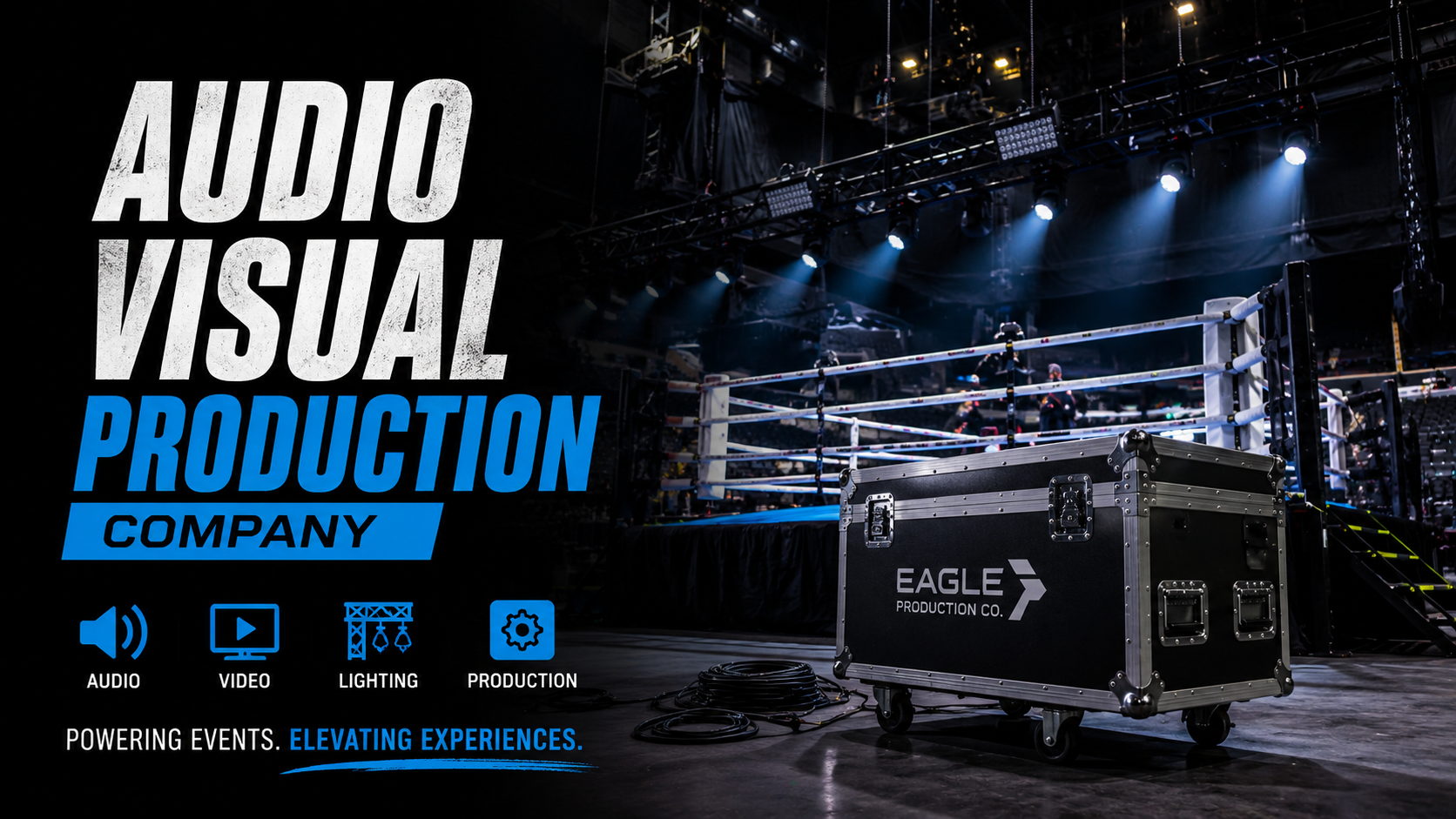
The phrase "audio visual production company" gets thrown around so loosely that it's lost most of its meaning. A DJ with a speaker is not an AV production company. A rental house that drops off gear at your loading dock is not an AV production company either. So what actually is one, and how do you tell the difference between a real production partner and a vendor who's overstating what they do?
This guide breaks down what a genuine audio visual production company delivers, when you actually need one, what to look for, and the questions that separate experienced production partners from costly mistakes.
What an audio visual production company actually does
A real audio visual production company is responsible for the entire technical execution of an event — from the first design conversation through equipment install, show operation, and final strike. That sounds obvious until you've worked with vendors who think their job ends at delivery.
The work breaks into four overlapping disciplines:
Audio — designing and operating sound systems sized to the venue and the audience. That means selecting the right line array, point-source, or distributed PA setup, choosing mixing consoles (DiGiCo, Yamaha, Midas, Allen & Heath), specifying wireless microphone packages, configuring in-ear monitoring for performers, and having an engineer at front-of-house who actually knows how to mix the show.
Video — LED video walls, projection systems, multi-camera capture and switching, video direction, and the streaming infrastructure that hybrid events demand. Modern event video has become a complete discipline of its own, with broadcast-grade workflows and dedicated technical directors.
Lighting — design and execution from a lighting designer programming a console (typically grandMA3 or ChamSys), with moving heads, LED fixtures, conventional theatrical lights, followspots, and atmospherics deployed to support the show, not distract from it.
Rigging and power — the unglamorous half of AV that holds everything else up. Truss, chain motors, ground support towers, generators, power distribution, and certified crew to deploy it all safely.
A genuine audio visual production company handles all four with depth, and assigns a single production manager who owns the project end-to-end. That single accountability is the most underrated benefit of hiring a real production partner.
When you actually need an AV production company
You don't always need full production. Some events are perfectly well served by a dry rental — equipment delivered, you set it up, you run it, you return it. If you have an experienced in-house technical team, dry rentals are often the right call. Browse a full equipment rental catalogue to see the inventory depth a serious AV house carries.
You need a full audio visual production company when one or more of these are true:
The stakes are high. A corporate keynote in front of executives, a brand activation in front of customers, a wedding you can't redo, a livestreamed event going to thousands of remote viewers. The cost of a technical failure exceeds the cost savings of going cheaper.
The technical complexity is real. Multi-camera switching, hybrid streaming, large LED walls, line-array audio, complex lighting design — anything beyond a simple PA and a couple of lights benefits from professional design and operation.
You don't have an in-house technical team. Most event planners, marketing teams, and corporate hosts don't, and shouldn't pretend otherwise. Operating a DiGiCo console or programming a grandMA3 in real-time is a specialist skill.
You want a single point of accountability. Sourcing audio from one vendor, video from another, lighting from a third, and rigging from a fourth means you're the integrator on show day. That rarely ends well.
What separates a real production company from a vendor
Five things distinguish a genuine audio visual production company from someone who's printed business cards with the title:
Inventory depth. Real production companies own their core equipment rather than subrenting everything. A walk-through of the warehouse shows scaled inventory across all four disciplines, not a thin fleet of mid-tier gear.
Named senior crew. A real production company assigns a specific front-of-house engineer, lighting designer, video director, and production manager to your event. You can meet them before show day. Vague "we'll send someone" answers signal a freelancer-rotation operation.
Pre-production process. Real production starts weeks before the event with site surveys, gear lists, signal flow diagrams, and a production schedule. Companies that quote off a paragraph email and show up on the day are not production companies.
Backup planning. What happens if the primary console fails? A wireless mic drops out? A projector lamp blows? Confident production companies have layered redundancy and explain it without prompting.
Documentation on request. Insurance certificates, rigging certifications, equipment specifications, references from comparable events. Real production companies produce all of this immediately. Hesitation is informative.
Questions to ask before booking
Before signing a contract:
What specific equipment — brand and model — will be on-site?
Who's the named technical lead for your event?
What's the backup plan for the most likely failure modes?
What insurance and certification can you document?
Can you share references from events comparable to mine?
A confident audio visual production company answers all five immediately. Hesitation on any of them is information.
Choose carefully
The right audio visual production company makes the technical side of your event invisible. Sound is clean, visuals are sharp, lights hit on cue, and the production becomes the platform for the actual content rather than competing with it for attention.
If you're scoping an event now, explore full event production services or get in touch to walk through your requirements with a team that handles everything from corporate keynotes to large-scale touring productions.